News · October 2026
Think-PLC Presents to the Siemens PAM Team in St. Pete Beach
Forty minutes in front of the Siemens account managers who cover the country: how we take a plant off a legacy platform, what we have built for the channel, and what the next eighteen months look like from the integrator's seat.
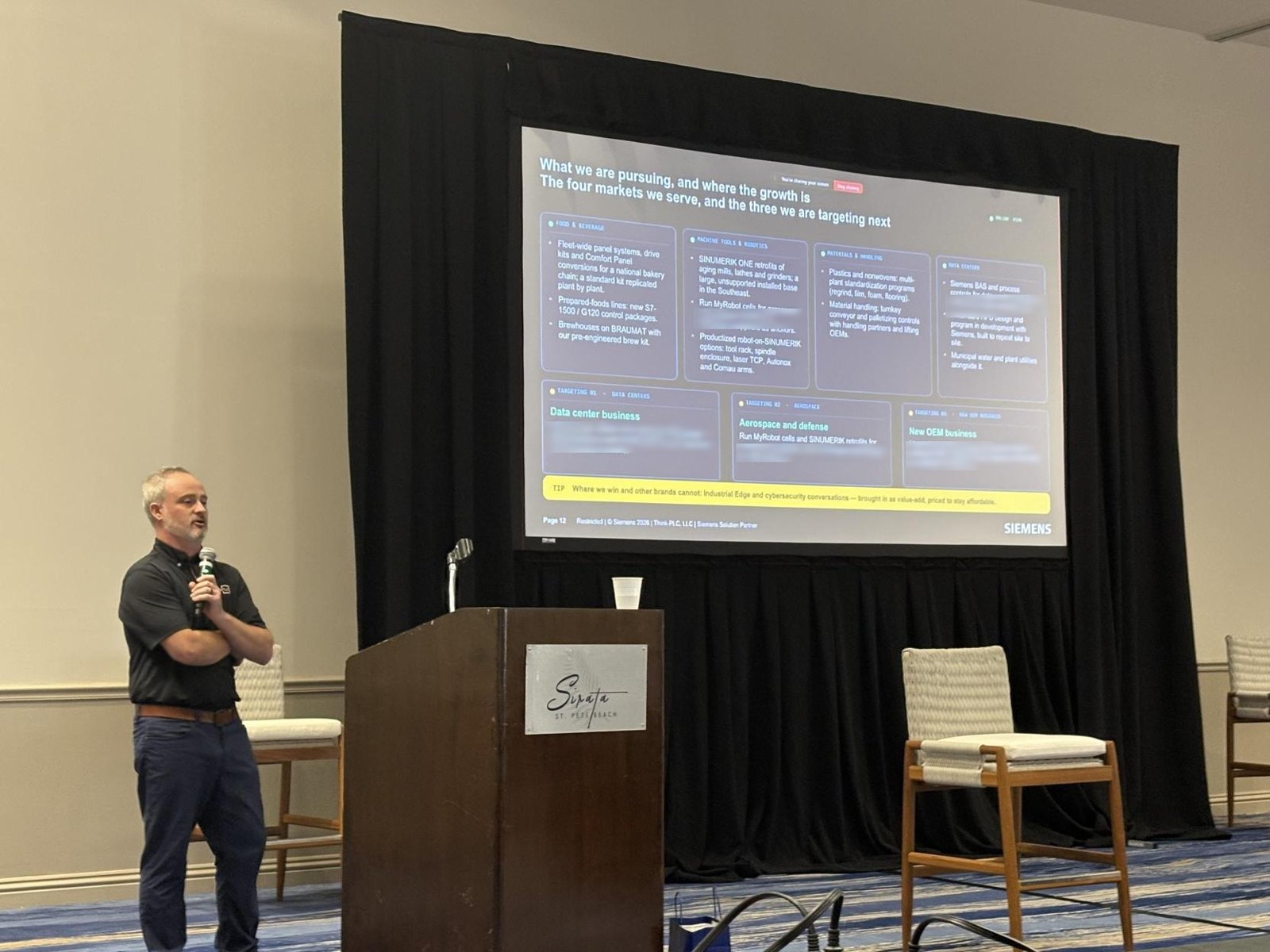
Siemens brought its Partner Account Manager team — the PAM team — together at the Sirata resort in St. Pete Beach, Florida, from September 29 to October 2, and invited Think-PLC to present. PAMs are the people who own Siemens' relationships with the solution partners, integrators and distributors who actually put the hardware in plants, and the room included account managers, specialists and leadership from across the Digital Industries business. Think-PLC was there as a Siemens Solution Partner, with a forty-minute slot on the morning of Wednesday, September 30.
It was also, as the room found out in the first two minutes, our CEO's birthday. Bobby Cole was born on September 30, exactly one hundred years after the Vulcan Street Plant in Appleton became the world's first hydroelectric station, which felt like a reasonable excuse to open a controls talk with a slide about the first power plant, Hoover Dam and the day Boeing rolled the 747 out of Everett. Five of the six things on that slide are still running. The point, made before the first number: big things get switched on in September, and they age well when they are built right.
One building, one phone number
The company overview is short because the building does most of the explaining. Think-PLC is 37 people in more than 20,000 square feet on Cole Road in Winston-Salem: the engineering office, the UL 508A panel shop, the fabrication floor and a training center with a live Siemens rig, all under one roof. Fourteen-plus controls engineers and technicians are in TIA Portal daily. In the last twelve months our field team made more than 180 site visits across 48 plants, on one support number, around the clock.
We hold four Siemens Solution Partner modules: Factory Automation, Drives & Motion, Machine Tool Systems and Industrial Edge. We are the only Run MyRobot Experienced Solution Partner and the only BRAUMAT and SISTAR Solution Partner in the United States. In 2026 alone our team earned 23 Siemens certifications, including five engineers now carrying Expert Industrial Edge. We are also a Rockwell Recognized System Integrator, Ignition certified and a FANUC robot integrator, and those credentials are not a hedge. They are precisely why plants trust us to move them.
How a plant actually moves to Siemens
The core of the session was the conversion playbook, and it is deliberately unglamorous. It starts with a plant walk alongside maintenance, not just purchasing, where we inventory every panel, PLC, drive and HMI and rank them by obsolescence risk and spare-parts exposure. Because we read legacy S5 and Rockwell code ourselves, nothing gets lost in translation. The output is a phased roadmap priced machine by machine rather than one frightening number.
Then we standardize: one platform of SIMATIC S7-1500 and ET 200SP, SINAMICS G120 drives and Comfort or Unified panels, one library and one HMI template suite so every machine looks and behaves the same to the operator. Panels are built and UL 508A listed in our own shop, with drawings and bill of materials on file for the life of the machine. Cutovers happen machine by machine on weekends and planned downtime, our own technicians commission, and the training happens on site or in our training center. After go-live the plant keeps the same team for 24/7 support, secure remote access, spares and field service.
The pitch to a plant manager is never that one brand is better than another. It is that they have thirty panels from four eras, their people cannot support them, and we can give them one standard, one integrator and one phone number, priced per machine so the first conversion is an easy yes and the rest follow.
Standard products and free tools, already online
The part of the session that surprised most of the room was the catalog. Over the past two years we have turned the panels we build most often into pre-engineered, UL 508A listed standard products with published prices, drawings on file and a three-year warranty, configurable and purchasable on think-plc.com/shop: Siemens HMI enclosures in 39 builds across thirteen sizes and three panel families, main PLC chassis with SITOP power backup, ET 200SP remote I/O panels, enclosed SINAMICS G120 drive packages in 104 variants from 2 to 75 horsepower, a BRAUMAT batch control kit, and the Run MyRobot spindle enclosure, tool-change rack and cabinet. When somebody needs a Siemens HMI station on a pedestal or an enclosed drive for a 50 horsepower fan, there is a link instead of a two-week quote cycle.
Alongside them are the smallest things we sell and the ones that spread fastest between panel shops: printed SIMATIC labeling strips matched to your I/O, and pre-terminated S7-1200 G2 wiring harnesses that take the slowest job in the panel off the bench.
And the free engineering tools, which need no login: the full-load amps calculator, the cut list optimizer, the subpanel layout designer, the enclosure cutout designer, instant quoting for laser-cut and CNC machined parts. They exist because our own engineers use them. We put them on the website so the next panel starts with the right parts list.
Machine tools and robots, where we are hardest to copy
The demonstration the room wanted to touch was SINUMERIK Run MyRobot: a six-axis arm driven as a machine-tool axis group by SINUMERIK ONE, programmed in G-code on the same Operate screens a machinist already knows, with no robot controller in the loop and no robot language. SIMATIC S7-1500F handles cell safety, Run MyVirtualMachine proves the program on a PC before it touches metal, and Think-PLC builds the cabinet, the tool rack and the spindle package. The live Operate widget we showed is the same one visitors can press CYCLE START on at our free SINUMERIK Channel Workshop on October 22.
WinCC Unified, running on a real plant
We also put a live WinCC Unified V21 application on the screen: the water treatment plant at the Town of Pennington Gap, with its treatment train, four S7-1200 filter consoles, drives, alarms and reports. Next to it, a read-only plant assistant that answers questions from live tags, alarms and the plant manuals, runs on the plant network with no internet connection, never writes a setpoint, and names the tag or the document behind every answer. Unified is not a preview product. It is something we deliver on today, native to the S7-1500 hardware already going in, with no OPC bridge and no second vendor to blame at three in the morning.
AI in engineering: what we actually expect
We are AI users, not skeptics, and we said so plainly. The configurators, the free tools, the product pages, the demo videos and a great deal of our estimating and documentation were built with AI in the loop, in months rather than years. That is what changed about being a 37-person company.
The concern we raised is not the technology. It is what happens on install day, when generated code meets real I/O, PROFINET, safety circuits and drives, and nobody on site knows why it does not run. Plants with thin controls teams will attempt conversions with a copilot and discount the engineering hours before the first panel is built, and "the integrator left" quietly becomes "the AI left." Our answer is to be the AI-fluent partner that is also hardware-proven: copilot-ready standards and libraries that give generated code a known-good hardware target, a fixed-price package to review, build, validate and commission customer-built or AI-assisted projects, and copilot workflows taught in our TIA course so customers learn what the tool cannot see. The place AI pays off first, we argued, is project support — configuration and bill-of-material checking before an order ships, and an assistant built into the panel so a plant can support itself. Code generation is the least of it.
The cycle we are selling into
The session closed on economics, using the same ITR Economics framing we have presented at CIMTEC and CCAT, plotted against live US industrial production data. The rates-of-change read puts us in Phase B, accelerating growth, with ITR expecting roughly 1.5 percent growth by the end of 2026, about 1.3 percent across 2027, and a softer patch from the second half of 2027 into the first half of 2028. Nondefense capital goods orders are up 7.3 percent year over year, led by AI and data center build-out. Manufacturing job openings are still north of 400,000, which is the real argument for automation: nobody is counting on the labor market to fix itself.
What that means practically: Phase B is the window. Multi-machine fleet standards get approved now, priced per machine, so they keep getting funded when 2027 budgets tighten. Sell conversions as productivity and energy rather than panels. Retrofits beat replacements in a soft patch. And keep hiring and certifying engineers through it, so you come out the other side with capacity your competitors cut.
Five plants, five platforms, one integrator
The stories we told were the ones that shipped. SixDigma in Ohio, where a robot holds machine-tool tolerances because it is driven as CNC axes and every job is proven in the digital twin first. A hybrid additive cell at CATCH in Charlotte that laser-weld prints, mills and induction heats on one SINUMERIK control, delivered inside an R&D window with requirements that kept moving. Nearly thirty panels standardized on SIMATIC across two plastics plants in North Carolina and California, where the first small panel set a standard that the rest of the fleet followed. A flooring line where 38 SINAMICS G115D distributed drives replaced aging PowerFlex units in a three-day shutdown, integrated with the running Rockwell PLC and HMI without rewriting a line of logic. And a 60-barrel brewhouse retrofitted onto Siemens BRAUMAT and back in business in two and a half weeks.
Different plants, different platforms, one integrator. That was the point of putting them on consecutive slides.
The sentence we left them with
Bring us in at the plant walk. We will turn a Rockwell plant into a Siemens plant, build it in our own shop, and stay to support it.
Thank you to the Siemens PAM team for the invitation, the slot and a genuinely good set of questions afterwards. If you have a plant full of panels from four different eras, a machine tool nobody can get parts for, or a project that needs to be made to run, talk to us — or come see the floor in Winston-Salem at the SINUMERIK Channel Workshop on October 22.